Written by: Matthew Timmins, Founder and Managing Director, Leva Sleep
Key Takeaways
- Adjustable bed motor noise is the top reason couples return bases or stop using adjustment features, so quiet operation becomes the most important buying criterion.
- Brushless DC motors with slow ramp speeds under 38 dB deliver the quietest performance, while brushed motors create audible arcing and vibration throughout each cycle.
- Rigid frame construction with center rails, secure joints, and proper leg support prevents vibration transfer that amplifies motor noise across the sleep surface.
- Split configurations reduce motion transfer when motors are matched, but mismatched motors from different production runs create disruptive asymmetric noise for light sleepers.
- Leva Sleep offers whisper-quiet German brushless motors in matched split configurations, so you can shop Leva Sleep today and experience uninterrupted sleep.
Whisper-Quiet Adjustable Beds: Under 38 dB With Slow Ramp Speed
Whisper-quiet adjustable bases sit below everyday bedroom noise, not just below marketing hype. The term appears on nearly every adjustable base page, but the threshold varies by source. Premium brushless DC motors in adjustable bases can operate at low decibel levels equivalent to a quiet whisper or library hum. Many tested models produce low noise levels.
The 38 dB figure used by Leva Sleep as its internal benchmark sits at the quieter end of that range, closer to a library than to rainfall. Ramp speed matters as much as peak decibels. A motor that accelerates abruptly produces a mechanical jolt and a brief spike in noise. A slow ramp-up distributes the load gradually and keeps the acoustic profile flat throughout the adjustment cycle. The 2012 Journal of Physiological Anthropology paper examined effects of thermal environment on sleep and circadian rhythm and did not address sound levels or noise, which means the difference between 38 dB and 45 dB can be clinically relevant for light sleepers. Even the quietest motor, however, will transmit vibration through a poorly constructed frame, which is why frame design becomes the second critical variable.
Quiet Frame Design That Controls Motor Noise
Frame construction determines whether motor vibration stays localized or spreads across the entire sleep surface. The quietest frames share three structural characteristics.
- Rigid side rails: Side rails that resist bending or twisting reduce overall bed movement and motion transfer when a partner shifts position.
- Center rail with floor-contact legs: A center rail with support legs that maintain firm floor contact reduces sagging and bouncing in queen and king beds, limiting vibration transfer across the sleep surface.
- Secure corner joints: Strong bolts and brackets at corner joints prevent the frame from rocking or twisting, which reduces motion transfer through the bed structure.
Platform beds are superior to box springs for reducing movement, noise, and motion transfer because their solid or tightly slatted construction provides a stable, non-springy base. When you evaluate a frame, press down on each corner and the center while the base is flat. Any flex or creak under static load will amplify once the motor starts moving.
Simple Fixes to Make an Existing Bed Frame Quieter
Owners of existing adjustable bases can often cut noise significantly with basic damping and decoupling steps instead of replacing the unit. These changes target how vibration travels from the motor into the frame, floor, and mattress.
Start by addressing the most common culprit, which is loose hardware. Tighten all bolts and brackets at regular intervals, because loose connections are the primary source of secondary rattling that amplifies motor hum. Once the frame feels mechanically tight, interrupt the vibration path at key contact points.
- Place rubber isolation pads between the frame legs and the floor to interrupt the vibration path, particularly on hardwood surfaces. Vibration-based massage on split king frames is quieter on carpet than on hardwood floors, where the noise can become noticeable enough to reduce relaxation benefits.
- Check slat spacing. Properly spaced slats, approximately 2–3 inches apart, create a more stable sleeping surface and can help limit motion transfer.
- Add a thin foam or felt layer between the mattress and the base deck to decouple surface vibration from structural vibration.
These tactics address secondary noise sources. If the motor itself is the primary noise generator, no amount of damping will bring a 55 dB brushed motor into whisper-quiet territory.
Quietest Motor Types for Light Sleepers
Brushless DC motors set the engineering standard for quiet adjustable base operation. The acoustic advantage comes from how current switches between motor windings. Brushless DC motors using sinusoidal or field-oriented control transition current gradually between windings to reduce torque ripple, unlike six-step trapezoidal commutation. Brushed motors rely on carbon brushes contacting a copper commutator, and that repeated electrical arcing and mechanical friction generates audible noise throughout the adjustment cycle.
For light sleepers evaluating a base, a quick in-store test provides clarity. Run the motor at its slowest ramp speed in a quiet room and measure with a free smartphone decibel meter app. Any reading above the 45 dBA threshold discussed earlier warrants further investigation.
Decibel Comparison: Motor Types and Real-World Noise
The following table presents manufacturer-stated or independently tested noise levels for five adjustable base motor types, showing that brushless DC motors deliver the quietest operation while AC motors often reach or exceed the 50 dB range that disturbs light sleepers. All figures are sourced to the references cited, and no independent testing was conducted for this article.
| Motor / Base Type | Noise Level | Motor Type | Source |
|---|---|---|---|
| Premium brushless DC (general category) | Quiet operation | Brushless DC | Mattress Miracle |
| Brushed DC (general category) | Moderate operation | Brushed DC | Mattress Miracle |
| AC motor (general category) | 50–60 dB+ | AC | Mattress Miracle |
| Helix Adjustable Base (tested unit) | Moderate noise | Not specified | Sleepopolis |
| Tami Tami T600 Split King (8000N dual motors) | Quiet operation | Dual motor | The Tools Trunk |
Real-world decibel anchors help put these numbers in context. A 30 dB sound equals a quiet whisper. A 40 dB sound equals a library. A 50 dB sound equals moderate rainfall, and a 60 dB sound equals normal conversation.
Motor Engineering Details That Affect Noise
The noise difference between brushed and brushless motors comes from internal structure, not cosmetic design. As noted earlier, brushed DC motors generate noise and vibration from electrical arcing at the commutator contacts and from torque ripple, which is especially noticeable at lower speeds. That speed range matches the slow, sleep-safe adjustments used at night. Brush arcing also creates electromagnetic interference (EMI), which can affect nearby electronics.
Ramp speed forms the second major variable. A motor that reaches full torque in 0.2 seconds produces a mechanical jolt and a sharp noise spike. A motor that ramps over 1–2 seconds distributes the load and keeps the acoustic signature below the sleep-disturbance threshold. Frame resonance forms the third variable. Increasing system stiffness by reinforcing rails, joints, and center support raises the bed’s natural frequency above the typical 0.5–2.0 Hz range of partner movements, which reduces resonance and vibration transmissibility.
Industry direction supports this engineering path. LOGICDATA debuted an adjustable bed system powered by brushless motion technology combined with a fully distributed BUS communication architecture, delivering minimized noise levels, improved driving dynamics, and plug-and-play upgradability. LOGICDATA Senior Development Engineer Branko Licardo stated, “By combining brushless precision with a true bus-based distributed control system, we are opening the door to quieter operation, cleaner designs, faster assembly, and unprecedented opportunities for future growth.”
Split King and Split Queen: Noise Tradeoffs and Benefits
Split configurations introduce a second motor into the system, which changes the noise profile in ways that matter to light sleepers. Two separate motors mean two separate noise sources, and asymmetric motor sound, where one motor runs quieter than the other, is more noticeable and disruptive to a light sleeper than uniform noise from a single base. This asymmetry risk peaks when bases from different production runs or model years are paired.
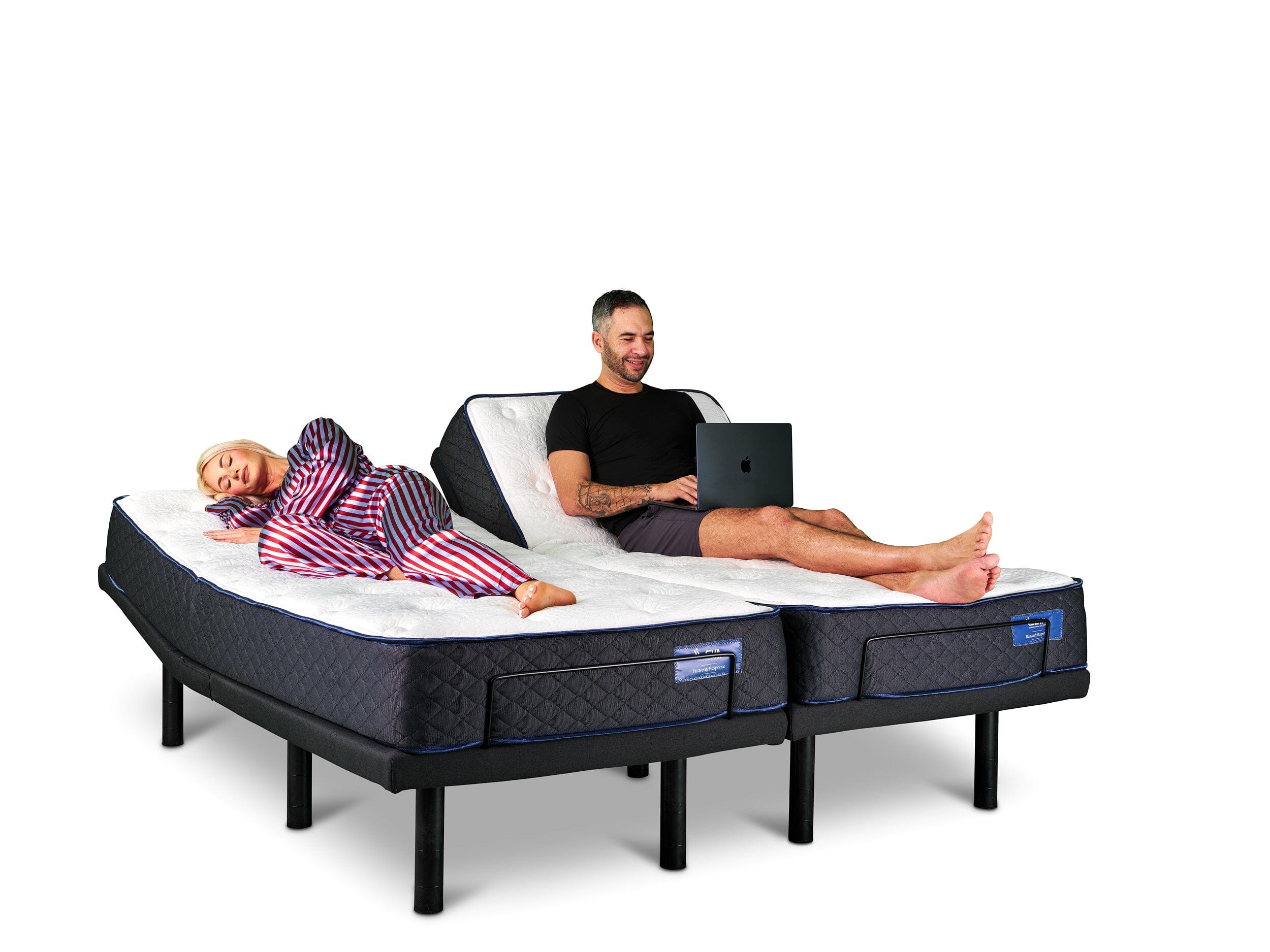
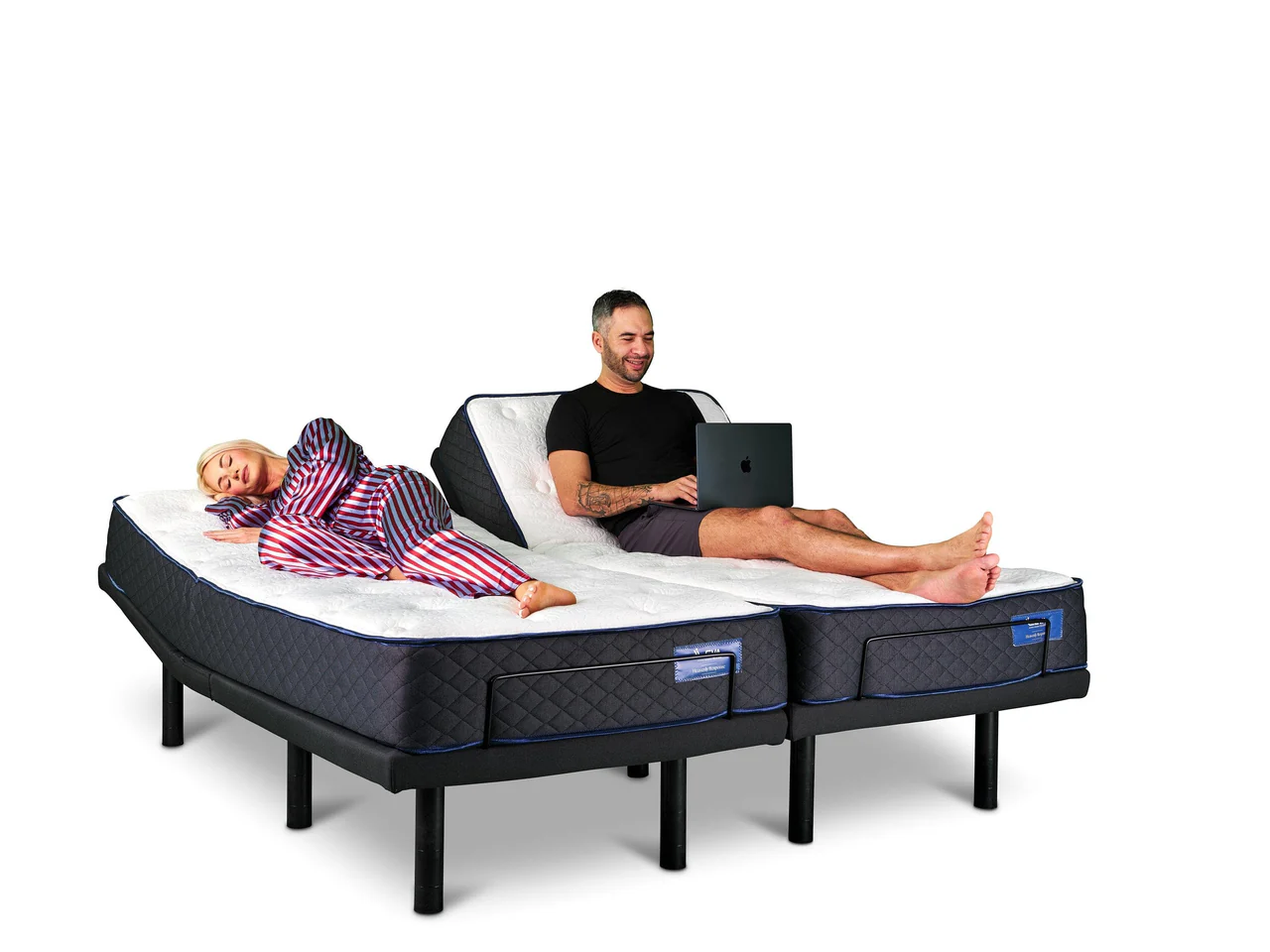
Split king configurations use two Twin XL frames. When each side operates completely independently, one partner can adjust position without motor noise transferring across the frame to disturb the other sleeper, provided the frame design keeps the two halves mechanically decoupled. Split foundations achieve the lowest motion transfer among foundation types because each side moves independently.
Split queen configurations offer the same independent-control benefit in a more space-conscious footprint, which helps in bedrooms where a split king’s 76-inch width feels impractical. Leva Sleep is one of the few specialists offering split queen adjustable bases built to customer specifications. The company pairs that configuration with matched whisper-quiet German motors on both sides to eliminate the asymmetric noise problem entirely.
Practical Ways to Reduce Vibration in Adjustable Beds
Vibration reduction in adjustable bases relies on two principles, isolation and damping. Isolation prevents vibration from entering a path. Damping dissipates vibration once it has entered.
- Frame rigidity: Solid bed frames reduce motion transfer by providing a stable, non-flexing foundation that prevents unnecessary movement or vibrations from amplifying.
- Material choice: Wooden or metal platform frames with a slatted or solid base offer strong motion isolation among bed-frame foundations.
- Decoupling the two halves: In split configurations, a gap or soft connector between the two bases prevents vibration from one motor from coupling mechanically into the other side’s frame.
- Floor surface: Carpet absorbs more vibration than hardwood. On hard floors, rubber isolation feet under each leg provide the single most cost-effective retrofit.
- Motor mounting: Motors mounted with rubber grommets rather than rigid bolts transmit less vibration into the frame deck.
Explore Leva Sleep’s vibration-isolating split configurations at the La Jolla showroom or online.
German vs Chinese Motors in Adjustable Bases
Motor origin often signals manufacturing standards, quality control tolerances, and expected service life. German-engineered motors used in premium adjustable bases are typically designed to medical-grade precision standards, the same supply chain that produces actuators for hospital beds and surgical equipment. Brushless DC motors are the preferred choice for medical pumps and diagnostic equipment that require silent, precise motion, and that same engineering discipline transfers directly to adjustable bed applications.
Key differences to evaluate when comparing motor origins include rated cycle life, EMI performance, maintenance needs, and consistency of noise output.
- Rated cycle life: German-engineered brushless motors in premium bases are designed for long service life. Brushless DC motors last 10,000 to 100,000 operating hours due to the absence of mechanical wear on brushes and commutator, while brushed DC motors have a typical service life of 1,000–5,000 hours limited by brush wear.
- EMI compliance: Brushless DC motors that meet EMC standards can provide reduced electromagnetic noise that does not affect device communication or cause malfunctions. Verify whether a motor carries relevant certification before purchasing.
- Maintenance requirements: Brushless motors require attention mainly to bearings, while brushed designs require periodic carbon brush replacement due to ongoing friction against the commutator.
- Noise floor consistency: Tighter manufacturing tolerances in German-engineered motors produce more consistent noise output across units, which reduces the asymmetric noise risk in split configurations.
Leva Sleep’s adjustable bases use whisper-quiet German motors on both sides of every split configuration. This approach ensures matched acoustic performance and removes the asymmetric noise problem that affects mismatched motor pairs.
Frequently Asked Questions
How long do motors on adjustable beds last?
Motor lifespan depends primarily on whether the unit uses brushed or brushless DC technology. As discussed in the motor comparison section, brushless DC motors last between 10,000 and 100,000 operating hours because there are no brushes or commutators to erode, so failure is limited mainly to bearing wear. For a couple adjusting their base twice daily for five minutes per adjustment, a brushless motor rated at 30,000 hours represents decades of reliable operation. When you evaluate a base, ask the manufacturer for the motor’s rated cycle life and whether it carries any independent certification for longevity.
Can you replace the motor on an adjustable bed?
Motor replacement is technically possible on most adjustable bases, but feasibility depends on the base’s architecture. Modular designs with accessible motor housings and standardized connectors allow a trained technician to swap a failed actuator without replacing the entire base. Integrated designs where the motor sits inside a sealed frame assembly are more difficult and expensive to service. Before purchasing, ask whether replacement motors are available as spare parts, what the lead time is, and whether the manufacturer or a local service partner can perform the replacement. Leva Sleep’s white-glove service model includes post-purchase support, which creates a meaningful advantage over brands that ship a base in a box and provide no local service infrastructure.
What are common problems with split queen adjustable beds?
Split queen adjustable bases solve the independent-control problem but introduce a small set of configuration-specific challenges. The most common issues include mattress gap management, where the two halves can drift apart over time without a proper connector or gap filler, and bedding fit, since standard queen fitted sheets do not accommodate two independently moving halves and require sheets with deep pockets and extra elastic. Motor asymmetry can also appear when two motors from different production batches produce slightly different noise profiles. Leva Sleep addresses all three by building split queen bases to customer specifications with matched motors and by offering a full suite of bedding accessories, including fitted sheets with extra elastic and duvet clips, designed specifically for adjustable configurations.
How do you evaluate noise levels before buying?
The most reliable evaluation method uses an in-person demonstration in a quiet environment. Visit a showroom, bring a free smartphone decibel meter app, and measure at one meter from the motor housing during a full head-elevation cycle at the slowest available ramp speed. A reading below 40 dBA at that distance indicates whisper-quiet performance. If an in-person visit is not possible, request the manufacturer’s stated dB specification and ask whether it was measured at the motor housing or at a distance, because the measurement point changes the number significantly. Also ask whether the figure applies to the slowest ramp speed or the fastest, since peak noise occurs at maximum acceleration. Finally, check whether the base has been tested by an independent reviewer using a calibrated meter, and compare that figure against the manufacturer’s claim.
Conclusion: Motors and Frames That Protect Your Sleep
The quietest adjustable bed base for couples comes from a combination of factors, not a single specification. Brushless DC motor technology, slow ramp speed, rigid frame construction, matched motors on both sides of a split configuration, and proper installation on a vibration-absorbing surface all work together. Each variable compounds the others. A brushless motor in a poorly constructed frame will still transmit vibration. A rigid frame with a brushed motor will still produce audible arcing noise at 50 dB or above.
Couples evaluating adjustable bases can use the criteria in this guide as a checklist. Verify the motor type and dB rating. Confirm the frame has a center support rail and secure corner joints. Ask whether split configurations use matched motors from the same production run, and test or request ramp speed specifications before purchasing.
Leva Sleep’s split queen and split king adjustable bases are engineered around whisper-quiet German brushless motors, app-controlled micro-adjustments including anti-snore positioning, and a white-glove delivery and setup service that ensures every component, base, mattress, and bedding, works as an integrated system from the first night. With over 25,000 customers served and 15–20 adjustable models available, Leva Sleep offers specialist depth that general mattress retailers cannot match.