
Written by: Matthew Timmins, Founder and Managing Director, Leva Sleep
Key Takeaways
- Chronic back pain, partner movement, and mismatched firmness preferences push many couples to seek advanced sleep systems that support both comfort and relationship needs.
- Integrated split adjustable systems outperform static hybrids, dual-air beds, and basic adjustable bases by offering independent lumbar elevation, head and foot positioning, and app-controlled micro-adjustments per side.
- Physically separate bases eliminate cross-side motion transfer and, when paired with whisper-quiet motors, reduce noise that can wake light sleepers.
- Professional white-glove delivery, long-term durability, and compatibility with flexible mattresses are essential factors for couples considering premium adjustable systems.
- Leva Sleep offers split adjustable systems designed specifically for couples; explore their options today to find a solution tailored to your needs.
How These Bed Categories Compare
Static hybrids combine foam comfort layers with pocketed coil support cores. They offer better pressure relief and motion isolation than traditional innersprings but provide no positional adjustment for either partner.
Dual-air systems (such as Sleep Number) use air chambers to allow independent firmness adjustment on each side. They do not elevate the head or foot independently and typically require proprietary accessories.
Basic adjustable bases are single-unit motorized frames sold by general mattress retailers as add-ons. They allow head and foot elevation but operate as one unit, so one partner’s adjustment affects the other.
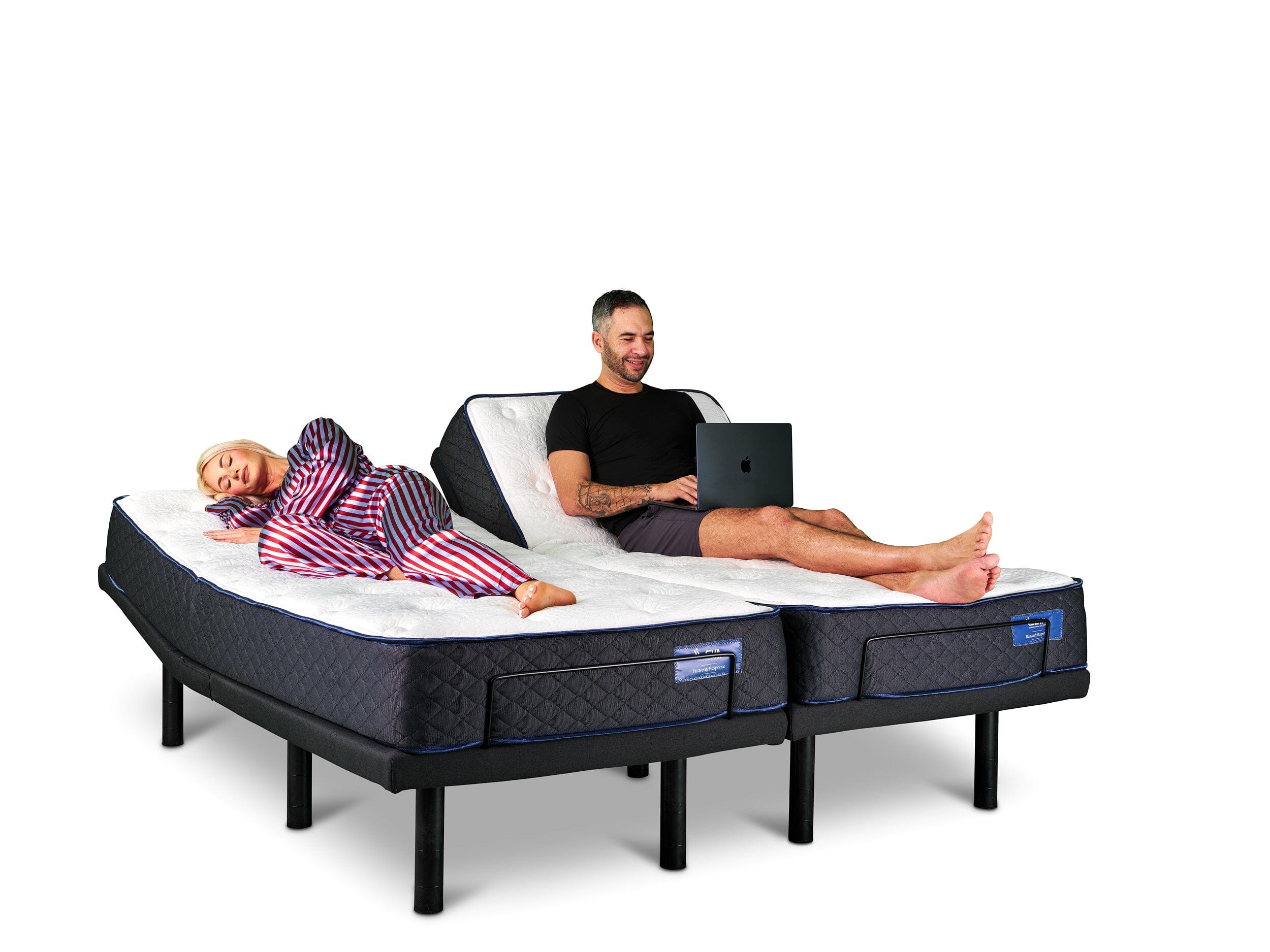
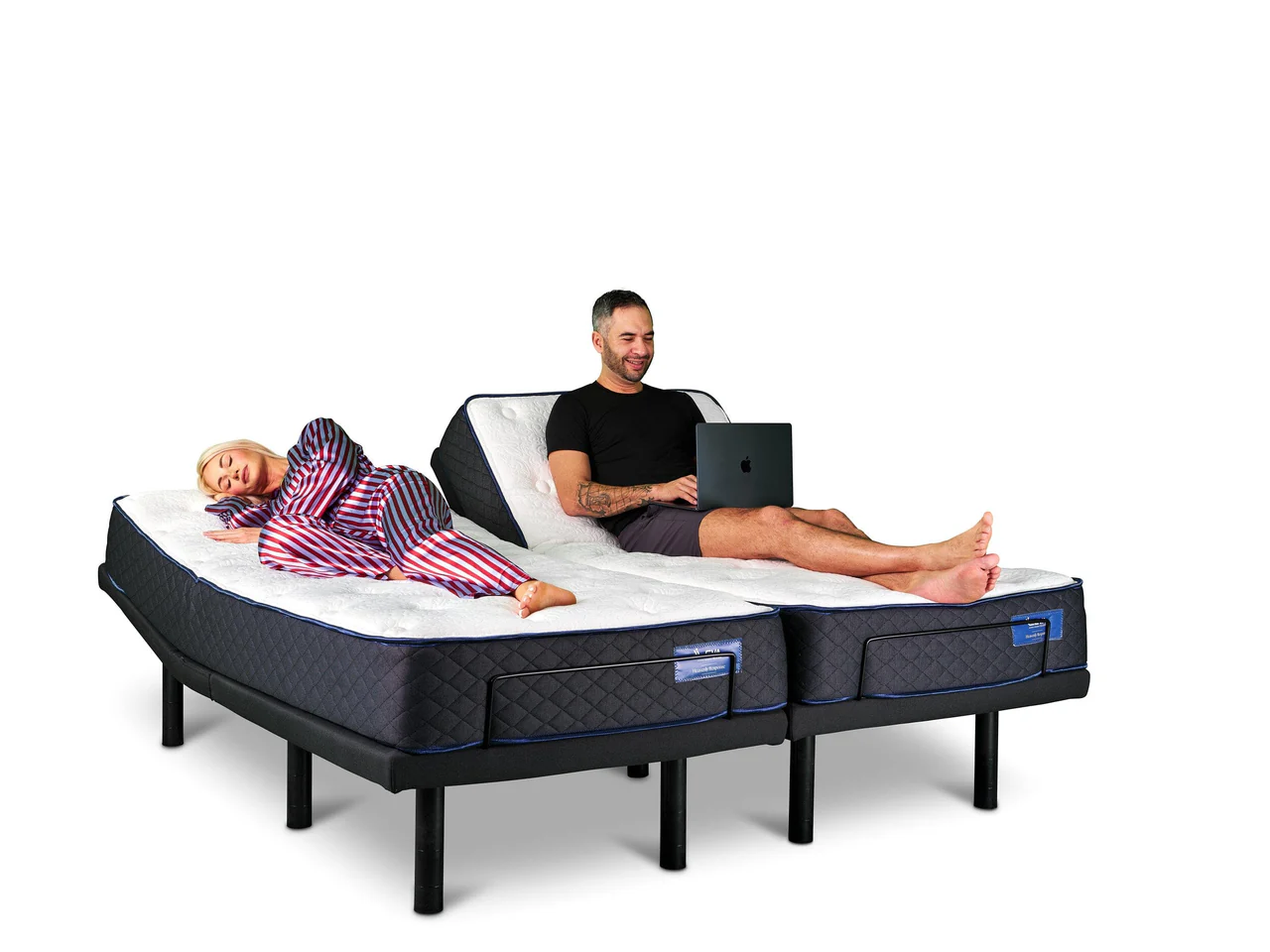
Integrated split adjustable systems pair two independent motorized bases side by side under a shared mattress configuration. Each side adjusts independently for elevation, lumbar support, and, on advanced models, anti-snore positioning, all controlled through an app.
Comfort and Targeted Lumbar Support for Back Pain
Comfort for back pain starts with spinal decompression and consistent support. Elevating the legs slightly on an adjustable base allows the lumbar spine to decompress, which can reduce lower back strain when paired with a supportive mattress. Static hybrids and dual-air systems cannot replicate this positional benefit regardless of their foam composition.
- Static hybrids: Pressure relief depends entirely on foam layering. No lumbar elevation is possible, and both partners share the same fixed surface.
- Dual-air systems: Independent firmness per side is a real advantage. Head and foot elevation are not available, so lumbar support remains passive rather than positional.
- Basic adjustable bases: Head and foot elevation are available, and some models include a lumbar support zone. Single-unit control means one partner’s adjustment moves the other side.
- Integrated split adjustable systems: Each side has independent lumbar elevation. App-controlled micro-adjustments let each partner dial in a precise lower-back position without affecting the other side.
| Criterion | Static Hybrid | Dual-Air System | Integrated Split Adjustable |
|---|---|---|---|
| Independent lumbar elevation | No | No | Yes, per side |
| Independent firmness per side | No | Yes | Yes (mattress-dependent) |
| Head/foot elevation | No | No | Yes, per side |
| Anti-snore positioning | No | No | Yes (select models) |
To experience how this type of lumbar support feels in person, visit the Leva Sleep La Jolla showroom or browse their split adjustable systems online.
Independent Adjustability for Two Sleepers
Independent adjustability lets each partner choose a position that supports their back without compromise. The main limitation of single-unit adjustable bases is that raising the head on one side raises it on both. For couples with different back pain profiles or sleep position preferences, this removes the core benefit of adjustability.
- Static hybrids: No adjustability, and both partners share one fixed position.
- Dual-air systems: Firmness adjusts independently per side, but elevation does not.
- Basic adjustable bases: Elevation adjusts as a single unit, so one partner’s preference overrides the other’s.
- Integrated split adjustable systems: Each side operates as a fully independent base. Independent adjustment systems with separate controls on each side enable couples to select different positions without moving the entire bed or negotiating settings.
When you compare split adjustable systems, look for app-controlled micro-adjustments via Bluetooth, whisper-quiet motors, anti-snore mode, and a pillow tilt motor. Each of these features should operate independently per side. The Split Queen configuration serves couples in smaller rooms who want split adjustability without a full Split King footprint.
Noise and Motion Isolation at Night
Quiet operation and motion control protect sleep continuity for both partners. Motor noise and motion transfer are separate issues. A system can isolate motion well but still produce disruptive mechanical sounds during adjustment, and the reverse can also occur.
- Static hybrids: No motor noise is present. Pocketed coil construction reduces motion transfer compared to traditional innersprings, although foam-only models isolate motion more completely.
- Dual-air systems: Air pump activation during firmness changes produces audible noise. Motion transfer between chambers varies by model.
- Basic adjustable bases: Motor quality varies widely. Budget models are often cited by consumers as producing disruptive noise during adjustment. Motion from one side transfers through a shared frame.
- Integrated split adjustable systems: Two physically separate bases eliminate cross-side motion transfer entirely. Motor noise depends on engineering quality. When you evaluate any adjustable base, check whether the manufacturer uses whisper-quiet motors that address the noise complaints common with entry-level adjustable bases.
Delivery and Setup for Complex Split Systems
Delivery and setup affect how quickly you can use a new system comfortably. A split adjustable system involves two motorized bases, a compatible mattress, app pairing, and accessory integration. The setup process is more complex than a standard mattress delivery.
- Static hybrids and dual-air systems: Typically delivered compressed or flat. The customer handles unboxing and placement, and no motor calibration is required.
- Basic adjustable bases: Delivery logistics vary by retailer. Many use third-party carriers with curbside or threshold delivery only, leaving motor calibration and app pairing to the customer.
- Integrated split adjustable systems: Setup complexity is highest, so professional installation is strongly advisable. Proper installation keeps both bases level, app-paired, and accessory-compatible.
When you review delivery options, check whether the provider offers in-house white-glove delivery. Trained professionals can deliver to the bedroom, assemble the system, adjust leg heights, pair the app, provide a product tutorial, and remove the old bed. This service is a meaningful differentiator for couples who want the system working correctly from the first night. You can see how Leva Sleep handles white-glove delivery by scheduling a showroom visit or exploring their setup services online.
Long-Term Durability and Overall Value
Durability and service costs determine the real value of a premium sleep system over time. Mechanical components, frame materials, and support policies all influence ownership experience.
- Static hybrids: Foam compression over time reduces pressure relief. No mechanical components can fail, and the replacement cycle typically ranges from 7 to 10 years.
- Dual-air systems: Air chamber integrity and pump longevity are the main failure points. Proprietary parts can raise long-term service costs.
- Basic adjustable bases: Motor and actuator quality determine lifespan. Budget models with plastic actuators degrade faster than steel-component alternatives.
- Integrated split adjustable systems: Motor quality, frame materials, and software update support all affect long-term value. When you compare options, check whether the manufacturer uses a direct-to-consumer model that removes retail markup and prices systems at 30 to 50 percent below comparable luxury competitors while still using German motor components.
Real-World Scenarios for Couples
Chronic lower back pain: Independent lumbar elevation per side is the most relevant feature. As explained earlier, this positional change supports spinal decompression. A split adjustable system lets the affected partner elevate without disturbing the other.
Snoring partner: Anti-snore technology that gently raises the upper body opens airways and provides support without multiple pillows that can slide, compress, or push the neck forward. Leva Sleep’s anti-snore mode detects snoring and makes automatic micro-adjustments to the head of the affected partner’s side only.
Post-surgery recovery: Precise, repeatable elevation positions matter most during recovery. App-saved custom positions allow a recovering partner to return to a prescribed angle without manual adjustment each night, while the other partner’s side remains unaffected.
Differing temperature needs: Split adjustable systems that work with heating and cooling pads let each partner regulate temperature independently. Leva Sleep’s systems integrate a heating and cooling pad as an accessory, addressable per side.
To match these scenarios to a specific configuration, you can visit the Leva Sleep showroom or review their Split King and Split Queen setups online.
Practical Buying Considerations
Mattress compatibility is a non-negotiable requirement for split adjustable systems. Standard mattresses with rigid foam borders or non-flex constructions can crack or deform under repeated articulation. Leva Sleep designs its all-foam and hybrid pocket coil mattresses specifically for adjustable base use. Its bedding accessories, including deep-pocket fitted sheets with reinforced elastic and duvet clips, are engineered to stay in place during elevation changes.
Trial periods and warranty terms vary significantly across categories. Buyers should confirm whether the trial period covers both the base and the mattress independently, and whether the warranty covers motor and actuator components separately from the frame. These details matter because health needs often change over time, and coverage should support that reality.
Health needs evolve. A system purchased primarily for back pain may later need to address sleep apnea, acid reflux, or post-surgical recovery. Evaluating a system’s full feature range, not just the features needed today, reduces the likelihood of an early replacement and protects the long-term investment.
Decision Checklist for Couples
Use the following checklist to connect your priorities to the five evaluation criteria before you compare specific products:
- Comfort and zoned lumbar support: Decide whether both partners need independent lumbar elevation or whether firmness adjustment alone is enough.
- Independent adjustability: Identify whether one partner’s preferred sleep position conflicts with the other’s. If it does, a single-unit base will not work.
- Noise and motion isolation: Note whether either partner is a light sleeper who wakes from mechanical sounds or movement. If so, prioritize whisper-quiet motors and physically separated bases.
- Delivery and setup: Decide whether professional installation is important or whether self-setup is acceptable. Factor in app pairing and motor calibration complexity.
- Long-term durability and value: Estimate the expected ownership period. Compare motor component quality and warranty terms, not just sticker price.
Frequently Asked Questions
Can a split adjustable base completely eliminate partner disturbance during the night?
Two physically separate bases eliminate cross-side motion transfer entirely because no shared frame connects the two sides. If one partner adjusts their position at 2 a.m., the other side does not move. This structure creates a clear advantage over a single-unit adjustable base or a shared mattress on a rigid platform.
Do chiropractors or physicians recommend adjustable bases for back pain?
Many physical therapists and physicians recommend sleeping in positions that decompress the lumbar spine, particularly for patients with lower back pain, herniated discs, or post-surgical recovery needs. Slightly elevating the legs reduces pressure on the lumbar vertebrae, and elevating the head can reduce acid reflux that disrupts sleep. An adjustable base is one of the few consumer sleep products that maintains these positions consistently throughout the night without pillow stacking.
How loud are adjustable base motors during adjustment?
Motor noise varies significantly by manufacturer and component quality. Entry-level bases with plastic actuators often produce grinding or clicking sounds that are audible across a room. Premium systems using precision-engineered steel motors, such as the German motors in Leva Sleep’s bases, operate at near-silent levels. When you evaluate any adjustable base, ask about motor decibel ratings and request an in-person or video demonstration of the motor running at full articulation range.
What is a Split Queen, and who is it designed for?
A Split Queen consists of two 30-inch-wide independent bases placed side by side, totaling the standard 60-inch Queen width. It provides the same independent adjustability as a Split King but in a smaller footprint, which suits couples in rooms where a 76-inch King width is impractical. When you evaluate providers, check whether they offer a Split Queen configuration built to customer specifications, since many brands limit split adjustable options to King sizes only.
What does white-glove delivery actually include, and is it worth the cost?
White-glove delivery for a split adjustable system typically includes in-room delivery, full assembly of both bases, mattress placement, leg height adjustment, app pairing and tutorial, and removal of the old bed. For a system with two motorized bases, proprietary app connectivity, and accessory integration, professional setup reduces the risk of misconfiguration that could affect motor performance or app functionality. The fee often makes sense for couples investing in a premium sleep system because it removes a major point of friction from the ownership experience.
Conclusion: Choosing a Split System for Two
For couples managing chronic back pain, snoring, or mismatched sleep preferences, the five criteria of lumbar support, independent adjustability, noise and motion isolation, delivery experience, and long-term value create a clear framework for comparison. Static hybrids and dual-air systems address some of these needs but not all. Basic adjustable bases introduce adjustability but sacrifice independence. Integrated split adjustable systems address all five criteria at once, with quality depending on motor engineering, software capability, and accessory ecosystem.
Leva Sleep’s split adjustable systems, available in Split King and Split Queen configurations, use whisper-quiet German motors and in-house white-glove delivery. They are built for couples who want to stay in the same bed without compromising individual sleep quality. To see which configuration fits your space and health needs, visit the La Jolla showroom or review Leva Sleep’s full system lineup online.