
Written by: Matthew Timmins, Founder and Managing Director, Leva Sleep
Key Takeaways
- A smart adjustable bed for couples needs a true split configuration, dual wireless or app remotes, automatic anti-snore positioning, and a wall-hugger design to give each partner real nightly independence.
- Split Queen bases fit most standard bedrooms while still providing independent elevation, massage, and app control on each side, so they work well for many couples.
- Wireless remotes with large backlit buttons and one-touch presets, paired with Bluetooth apps for deeper programmability, let both partners adjust positions without disturbing sleep.
- Anti-snore modes that automatically detect snoring and make micro-adjustments to the head section help reduce airway restriction without waking either partner.
- Leva Sleep offers whisper-quiet German motors, Split Queen and Split King options, and in-house white-glove delivery; shop Leva Sleep today to experience these features firsthand.
How to Choose a Smart Adjustable Bed for Two Sleepers
Smart adjustable beds for couples succeed when each partner can raise or lower their side of the bed without affecting the other. Independent controls give couples individual comfort settings without mutual disruption during sleep, and every base in this comparison addresses that need in a different way.
Several popular models appear in couple-focused searches: Tempur-Ergo, Sleep Number 360, Leggett & Platt, Saatva Adjustable Base Plus, Ghostbed Adjustable Base, and Leva Sleep Split systems. When you evaluate any of them, focus on four criteria: whether the base ships as a true split configuration, what type of remote or app comes in the box, what the stated warranty covers, and whether independent adjustability on both sides is standard or an extra-cost upgrade.
Tempur-Ergo and Sleep Number 360 both offer split-king configurations with app control. Saatva and Ghostbed sell adjustable bases primarily as mattress add-ons, with fewer model variants. Leggett & Platt supplies OEM bases to multiple brands, so feature sets vary by retailer. Leva Sleep offers 15–20 adjustable models, including a proprietary Split Queen configuration that most competitors do not stock, and treats the adjustable base as the primary product rather than an accessory.
Warranty terms range from one year on entry-level bases to 10–25 years on premium models. Confirm whether the warranty covers the motor, the frame, and the remote independently, because these components often carry different coverage periods.
Once you know which brands meet your control and warranty requirements, the next step is choosing the physical size and split configuration that fits your bedroom and sleep style.
Split King vs Split Queen for Real Bedrooms
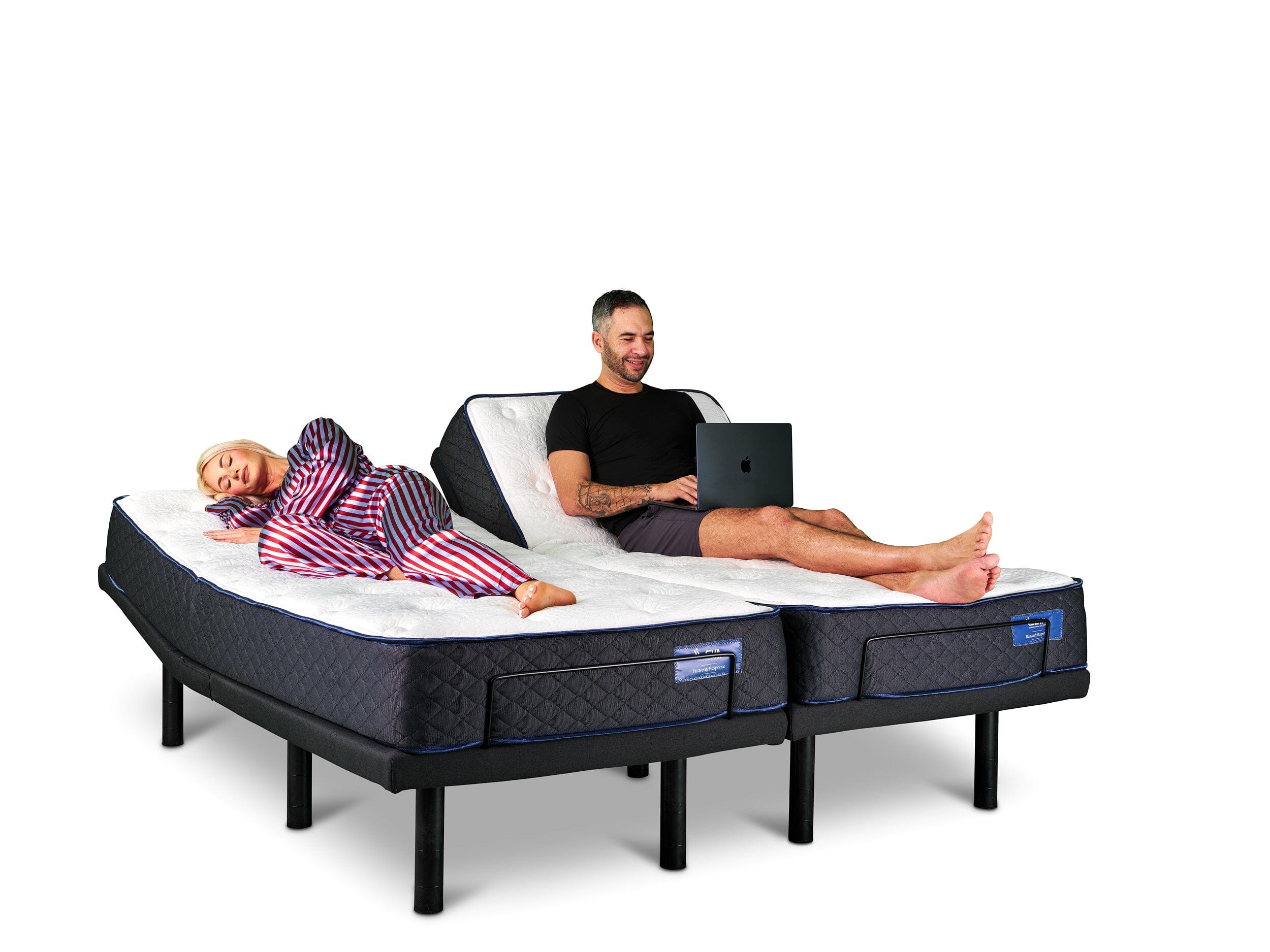
A split king adjustable bed uses two Twin XL mattresses, each 38 inches by 80 inches, placed side by side to create a total footprint of 76 by 80 inches. A split queen divides a 60-by-80-inch surface into two 30-by-80-inch halves, so each partner receives the same per-sleeper width as on a standard non-split queen.
Split kings isolate motion 74–82% better than traditional kings because each partner sleeps on a physically separate mattress. That isolation introduces a trade-off, because split king setups create a gap between the two mattresses that many couples find uncomfortable when they want to stay physically close.
The split queen addresses the space problem directly. The recommended minimum bedroom size is 10 by 10 feet for a queen bed versus 12 by 12 feet for a king, which makes the split queen the practical choice for most Southern California bedrooms. Leva Sleep is one of the few brands that builds Split Queen adjustable bases to customer specifications, with independent elevation, massage, and app control on each 30-inch half, all without requiring a king-sized room.
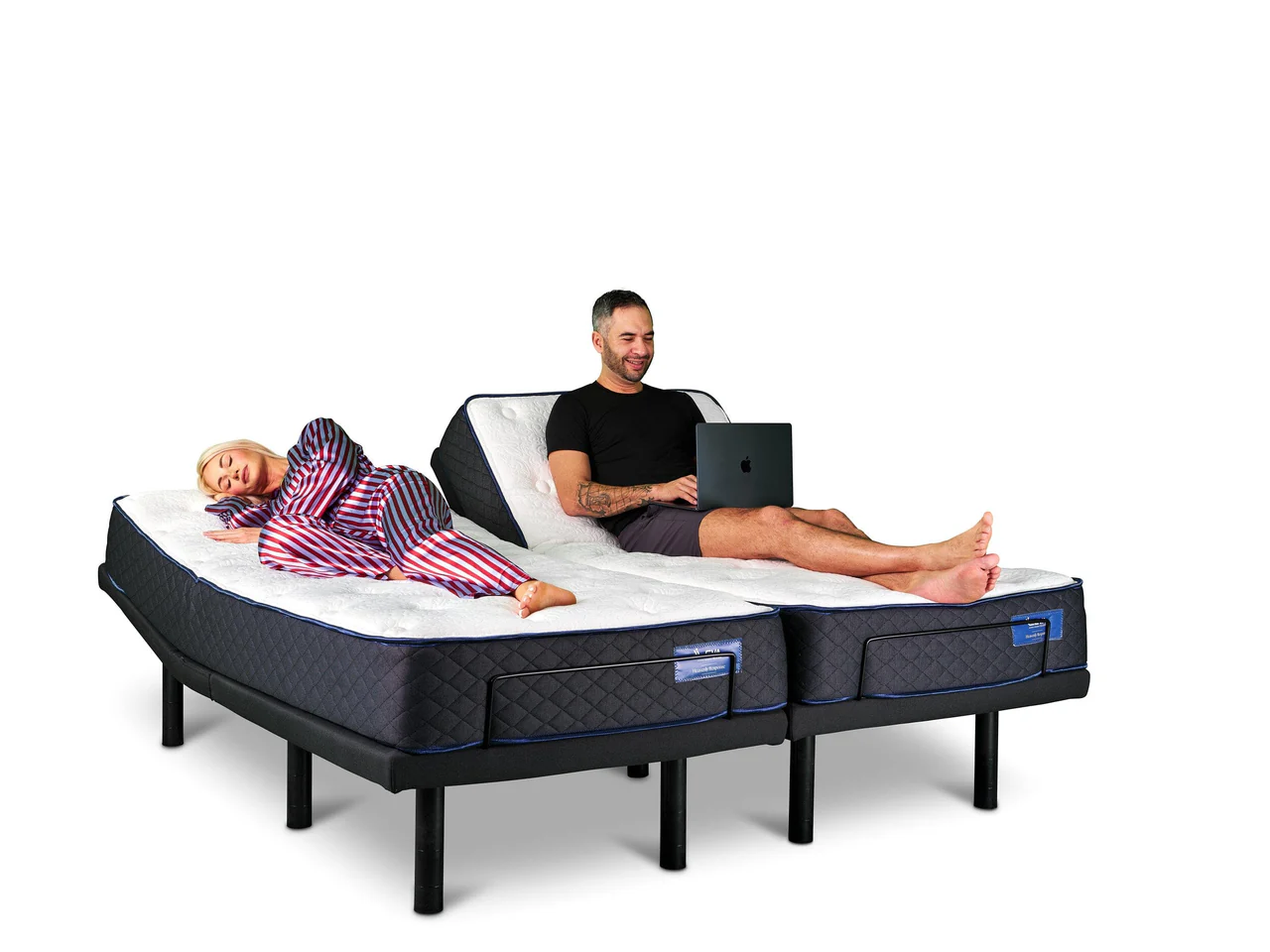
Couples who prioritize personal space and have larger bedrooms can focus on the split king. Couples working with standard bedroom dimensions, or those who want to minimize the center gap, should start with the split queen.
Remote Controls and Apps That Couples Actually Use
Remote usability determines whether couples use the features they pay for every night. The most functional adjustable bed remotes feature large, well-spaced buttons with tactile feedback, backlit displays, and a limited set of 6–8 core functions. Buttons should have a minimum 12mm diameter, the remote should weigh under 200 grams, and high-contrast labels or universal icons significantly improve usability.
One-touch buttons for flat, TV, and zero-gravity positions remove the need to hold buttons during adjustment. This feature matters most during nighttime use when a partner is already asleep. On a split-king or split-queen setup with two separate bases, each side should have its own remote so partners can adjust independently without disturbing each other.
App-based control adds programmability that physical remotes cannot match. Bluetooth-based bed control apps support up to four independent adjustment options, such as back, leg, neck, and foot, and include silent alarm features that wake users via massage or automatic movement to a saved position. A bed selector offering single, double, and synchronized modes supports independent or coordinated control in couples’ split configurations.
Tempur-Ergo and Sleep Number 360 both ship with dedicated apps. Leva Sleep’s proprietary app includes custom sleep position saving, vibrating alarms, and subtle anti-snore micro-adjustments. When you evaluate any remote or app, confirm whether preset positions save per side independently and whether the app needs a Wi-Fi hub or operates over Bluetooth alone.
Anti-Snore and Health Positions in Current Models
Anti-snore positioning works by gently elevating the head section of the base to reduce airway restriction. The elevation angle, detection method, and response speed differ across 2026 models and determine how well each system addresses snoring without waking the non-snoring partner.
Sleep Number 360 uses its SleepIQ biometric sensor layer to detect breathing irregularities and automatically adjust head elevation. Tempur-Ergo’s Ergo Smart Base uses a snore-detection algorithm tied to its app. Both systems require the mattress and base to be purchased together for the detection feature to function. Saatva and Ghostbed offer preset anti-snore elevation angles but do not include automatic detection in their 2026 base configurations.
Leva Sleep’s anti-snore mode, available in 2026, detects snoring and makes micro-adjustments to the head of the bed to reduce or eliminate snoring without requiring a proprietary mattress pairing. The system gently elevates the head to open airways, which can offer an alternative to CPAP masks for couples managing mild sleep apnea. Zero-gravity presets, which elevate both the head and feet to distribute body weight evenly, appear across Leva’s lineup and can be saved as one-touch positions on the remote or app.
When you compare anti-snore features, ask each brand whether detection is automatic or preset-only, what elevation angle the anti-snore position targets, and whether the feature operates independently on each side of a split configuration. These answers help you match the feature set to your snoring pattern and your partner’s sleep sensitivity.
Quiet Motors and Wall-Hugger Frames for Shared Sleep
Motor noise is the most common complaint among couples who move from a flat bed to an adjustable base. Cheap adjustable bases use loud motors that run for 10–15 seconds per adjustment, which is long enough to wake a sleeping partner. High-torque motors for adjustable beds typically operate at speeds of 4.6–6.8 mm/s.
Placing the motor at the base of the frame both protects it from pressure and muffles operational noise. Most operational noise in adjustable bases comes from room acoustics, loose hardware, or objects vibrating under the base rather than motor defects. Keep this in mind when you evaluate noise complaints in showrooms or reviews.
Leva Sleep’s bases use whisper-quiet German motors, a specification that distinguishes them from OEM bases used by several competitors. German-motor availability in 2026 configurations is a differentiating factor worth confirming at the point of purchase. Wall-hugger design, where the base slides the sleeping surface forward as the head rises and keeps the sleeper close to the nightstand, is standard on Leva’s premium models and available as a feature tier on Tempur-Ergo and Leggett & Platt-based systems. Confirm wall-hugger functionality before purchase if nightstand access during elevated positions matters to you.
Mattress and Bedding Fit for Adjustable Bases
Not every mattress flexes safely on an adjustable base. All-foam and hybrid pocket-coil mattresses are the two formats that work with articulating bases. Traditional innerspring mattresses with connected coil systems do not. Split king configurations allow each sleeper to select different mattress types, such as memory foam on one side and hybrid on the other, which increases partner independence beyond elevation control.
Bedding compatibility creates a practical challenge that many buyers overlook. Split king configurations require special sheet sets that include two Twin XL fitted sheets and one large king-sized flat sheet to allow independent movement while maintaining a unified appearance. The same principle applies to split queens, where standard fitted sheets often pop off during elevation.
Leva Sleep designs its fitted sheets with deep pockets and extra elastic specifically for adjustable bases, and offers duvet clips that maintain separation when each side sits at a different elevation angle. These accessories come as part of an integrated system rather than as aftermarket additions, which reduces the trial-and-error process that buyers typically face when sourcing bedding independently.
Delivery, Setup, and Service After the Sale
Adjustable bases weigh significantly more than flat frames and need professional setup to work correctly. Standard delivery services drop the product at the door. White-glove services bring it to the bedroom, assemble the base, adjust leg heights, connect the app, and remove the old bed.
Sleep Number and Tempur-Pedic offer white-glove delivery through third-party logistics partners. Saatva includes white-glove delivery in its base price. Ghostbed offers threshold delivery as standard, with white-glove available at an additional cost.
Leva Sleep provides in-house white-glove delivery for a fee, using trained professionals rather than contracted logistics teams. The service includes old bed removal with donation or recycling, product tutorials, and real-time leg-height adjustments. Because Leva controls the delivery process internally, the setup team knows every model in the lineup, which differs from brands that outsource final-mile delivery to generalist carriers.
For long-term service, confirm whether the brand’s warranty is serviced in-house or through a third party, and whether replacement parts, particularly motors and remotes, remain available after the warranty period ends.
Decision Checklist for Couples Ready to Buy
With delivery logistics and service terms clear, the final step is matching your specific sleep challenges to the features that address them most directly. Map your primary pain point to the evaluation criteria below before you contact any brand.
- Snoring or mild sleep apnea: Prioritize automatic anti-snore detection over preset-only elevation, and confirm the feature operates independently on each side of a split base.
- Differing firmness preferences: Require a true split configuration with separate mattresses, and evaluate split queen for smaller bedrooms and split king for larger rooms.
- Pressure in hips, shoulders, or lower back: Confirm zero-gravity preset availability and lumbar support adjustment on each side independently.
- Partner movement disruption: Prioritize motion isolation; as noted earlier, split configurations provide significantly better isolation than traditional kings.
- Noise sensitivity: Ask for motor specifications, because German-motor or high-torque motor designations usually indicate faster, quieter adjustments.
- Remote usability: Handle the physical remote before purchasing; a remote that is too complicated means many features go unused.
- Bedroom size: Measure carefully before selecting a split king, and refer to the size comparison above if your bedroom is under 12 by 12 feet.
Frequently Asked Questions
Can a smart adjustable bed actually reduce snoring, or is that a marketing claim?
Head elevation can reduce airway restriction by shifting soft tissue away from the throat. Anti-snore modes on 2026 bases either detect snoring automatically through biometric sensors or let users save a preset elevation angle as a one-touch position. Automatic detection responds faster than manual adjustment and does so without waking either partner. Effectiveness varies by individual anatomy and snoring cause. Positional snoring responds well to elevation, while snoring caused by nasal obstruction or severe sleep apnea may require additional medical intervention. Leva Sleep’s 2026 anti-snore mode uses micro-adjustments to the head section and operates independently on each side of a split base.
What is the difference between a Split Queen and a Split King, and which is better for a standard bedroom?
A Split Queen divides a 60-by-80-inch surface into two 30-by-80-inch halves. A Split King divides a 76-by-80-inch surface into two 38-by-80-inch Twin XL halves. The Split King gives each partner 8 more inches of width but requires a larger room, with a minimum of 12 by 12 feet versus 10 by 10 feet for a queen-sized footprint. For most standard bedrooms in Southern California, the Split Queen is the more practical configuration. Both formats deliver full independent elevation, massage, and app control on each side. Leva Sleep builds Split Queen bases to customer specifications, which remains uncommon among major adjustable bed brands.
Will fitted sheets stay on an adjustable base when the head or foot is elevated?
Standard fitted sheets are not designed for the range of motion an adjustable base produces and often pull off the corners during elevation. The solution is a fitted sheet with deep pockets, typically 18 to 21 inches, and reinforced elastic around the entire perimeter rather than just the corners. Split configurations require two separate fitted sheets, one per side, sized to the individual mattress half. Leva Sleep designs its fitted sheets specifically for adjustable bases with extra elastic and deep pockets, and sells them as part of an integrated bedding system that includes duvet clips for split-elevation use.
How loud are adjustable bed motors during nighttime adjustments?
Motor noise depends on motor quality, adjustment speed, and installation surface. Entry-level bases with standard motors can run for 10 to 15 seconds per adjustment, which is long enough to wake a sleeping partner. High-torque motors that operate at approximately 11 mm per second complete adjustments in roughly half that time and produce less audible noise. Hard floors amplify vibration, so placing rubber caster cups or carpet squares under the base legs reduces transmitted sound. Leva Sleep uses whisper-quiet German motors across its premium lineup, which complete adjustments faster and more quietly than the OEM motors found in many competitor bases.
Is a physical wireless remote or a smartphone app better for controlling an adjustable bed at night?
Both play useful roles in a split-base setup. A physical wireless remote with backlit buttons and one-touch presets is faster to use in the dark and does not require unlocking a phone or navigating an interface. A smartphone app provides deeper programmability, including saved positions, sleep tracking, silent vibration alarms, and anti-snore micro-adjustment scheduling, which a physical remote cannot match. The most functional setups include both options, with a physical remote for immediate nighttime adjustments and an app for programming and scheduling. Leva Sleep’s system ships with both, and the app supports independent control of each side of a split configuration.
Conclusion
Choosing the right smart adjustable bed for couples in 2026 means matching specific pain points to specific features. Snoring and airway issues point toward automatic anti-snore detection with independent side control. Differing firmness needs call for a true split configuration with separate mattresses. Pressure relief depends on zero-gravity presets and lumbar adjustment. Noise sensitivity narrows the field to bases with German or high-torque motors. Bedroom dimensions determine whether a Split King or Split Queen offers the most practical fit.
Leva Sleep addresses all five criteria within a single product ecosystem, with Split Queen and Split King bases that use whisper-quiet German motors, a 2026 anti-snore mode, dual wireless remotes and app control, wall-hugger design, and in-house white-glove delivery at 30–50% below comparable luxury competitors. With 15–20 adjustable models and eight years of specialist expertise, Leva offers a depth of configuration that general mattress retailers do not match.
Transform your sleep with Leva Sleep by visiting the La Jolla showroom or shopping online today.