Written by: Matthew Timmins, Founder and Managing Director, Leva Sleep
Key Takeaways for Snoring Relief
- Split king adjustable beds let each partner raise their head independently to open the airway and reduce snoring without disturbing the other side.
- Automatic anti-snore detection systems respond in real time to snoring sounds, while preset modes rely on a fixed elevation angle you set before sleep.
- Key evaluation criteria include head-elevation range (7–30 degrees), independent controls, quiet motors, and total cost of ownership including bedding and delivery.
- Leva Sleep, Tempur-Pedic, Saatva, Sven & Son, and GhostBed cover a range of automatic and preset options at different price points and service levels.
- Shop Leva Sleep’s split king adjustable bases today for automatic anti-snore technology, whisper-quiet motors, and white-glove delivery at direct-to-consumer pricing below typical luxury retail.
How Split King Adjustable Beds Reduce Snoring
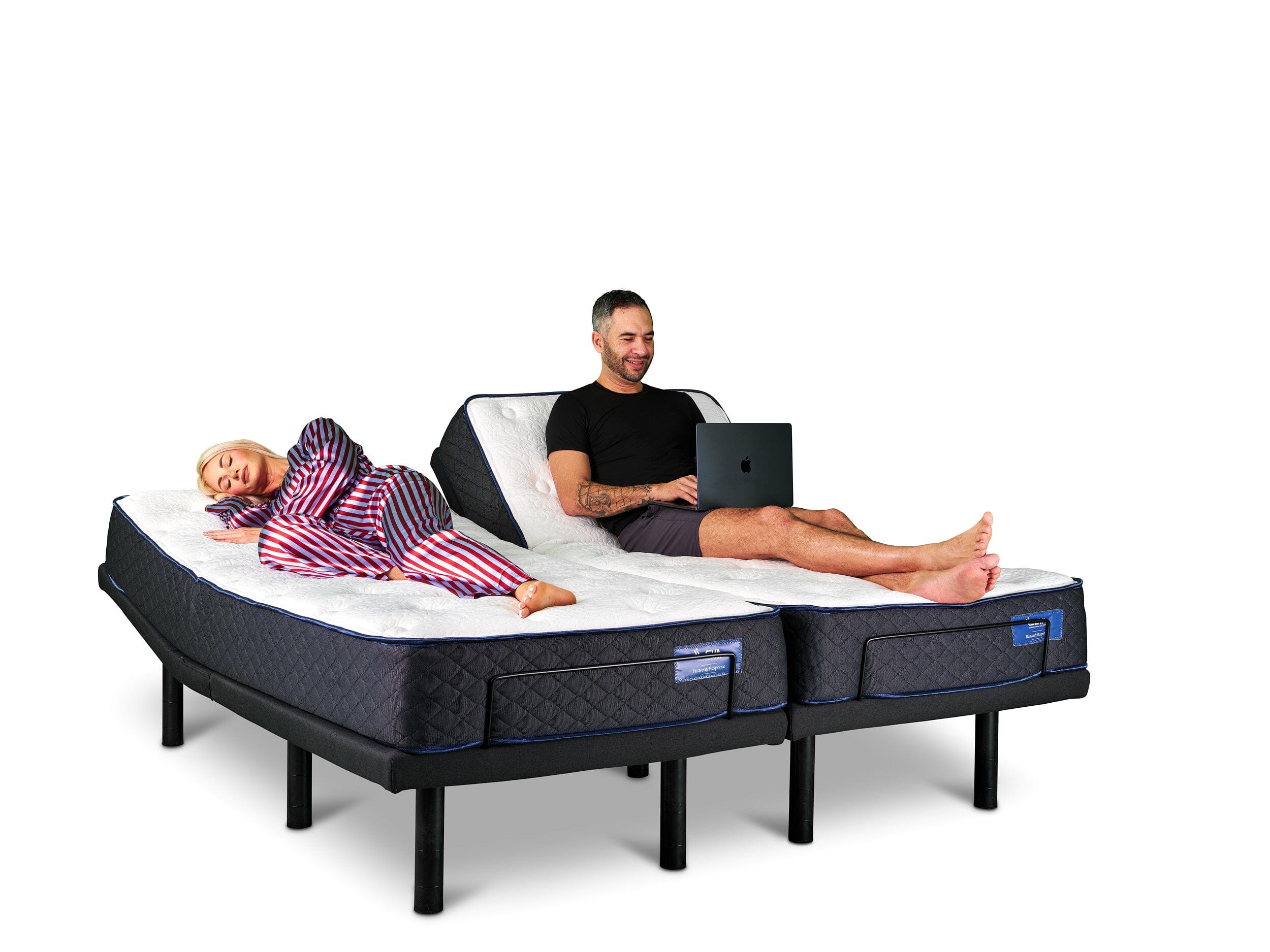
A split king adjustable bed uses two Twin XL mattresses on independent adjustable bases, so each sleeper controls their own head and foot positions. This setup directly supports snoring relief because peer-reviewed studies show head-of-bed elevation between 7.5 and 30 degrees reduces apnea-hypopnea index scores and upper airway collapsibility in positional obstructive sleep apnea patients. When the head is elevated, gravity shifts soft tissue in the throat forward and reduces the airway obstruction that creates snoring sounds.
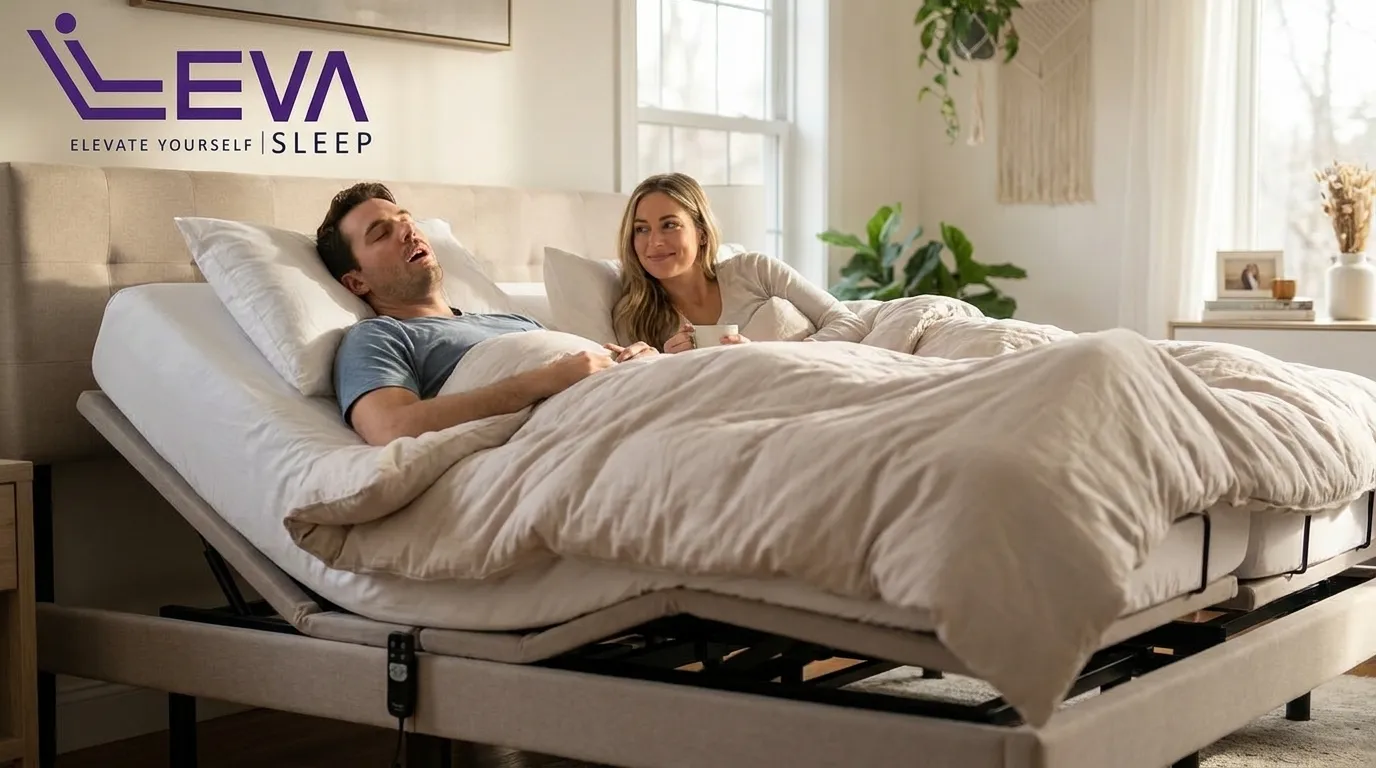
The independent controls in a split king mean one partner can elevate their head to a therapeutic angle while the other remains flat or chooses a different position. Couples testing split king adjustable beds for snoring reported that they could adjust their partner’s side manually or automatically for relief without waking the other person. This independence is the defining advantage of a split king over a standard king base with a single motor and shared elevation.
Split frames now represent a large share of the adjustable bed market, which reflects strong demand for dual customization that lets each sleeper address their own needs without compromise.
Anti-Snore Modes: Preset vs Automatic Detection
Anti-snore features in adjustable beds fall into two clear categories. A preset mode lets you manually program a fixed head-elevation angle, usually between 7 and 15 degrees, before you fall asleep. The bed then holds that position all night, even if snoring never starts or later stops. Anti-snore mode on bases such as the Saatva Adjustable Base Plus slightly elevates the head to ease airway pressure, but users may need to experiment to find the best angle for their body.
A automatic detection mode uses sensors or microphone technology to identify snoring sounds in real time and then trigger small head-position changes without your input. Tempur-Pedic’s Snore Response™ technology senses snoring and automatically raises the head approximately 12 degrees, and the company states this feature may reduce snoring in otherwise healthy individuals who snore due to body position. Automatic detection offers a more advanced and responsive solution, while preset modes provide a simpler but less adaptive approach.
How to Choose an Adjustable Bed for Snoring
Choosing a split king adjustable base for snoring works best when you compare four criteria across every option.
- Head-elevation range: Look for a range of at least 7 to 30 degrees, which matches the clinically validated therapeutic window mentioned earlier.
- Independent controls: Each side must articulate separately. A shared motor prevents couples with different elevation needs from getting full benefit.
- Motor noise: Motor noise from an adjustable base can become a new sleep disturbance if the mechanism is not quiet, so silent or near-silent operation becomes a core performance requirement.
- Total cost of ownership: Consider the base price, mattress compatibility, specialized bedding, and delivery or setup fees. A low sticker price paired with noisy motors or incompatible bedding often increases the real cost of the system.
The following five products show how current split king bases stack up across automatic detection, preset modes, and entry-level options when measured against these criteria.
1. Leva Sleep Split King Adjustable Base With Automatic Detection
The Leva Sleep Split King Adjustable Base uses an integrated anti-snore system that focuses on automatic response. Its app-driven micro-adjustment feature detects snoring and makes subtle head-elevation changes in real time. This approach moves beyond fixed presets and responds to each sleeper’s breathing patterns throughout the night. The head elevation range covers a wide therapeutic window, and the Leva Sleep app controls Bluetooth functions such as custom position memory, vibrating alarms, and per-side adjustment without disturbing the other partner.
Each side of the split king runs on whisper-quiet German motors, which addresses one of the most common complaints about adjustable bases: mechanical noise that creates a new source of sleep disruption. Independent controls allow the snoring partner’s head to rise automatically while the non-snoring partner remains in a flat or custom position. The base is designed for couples, and the split configuration keeps motion transfer between sides at a minimum during adjustment.
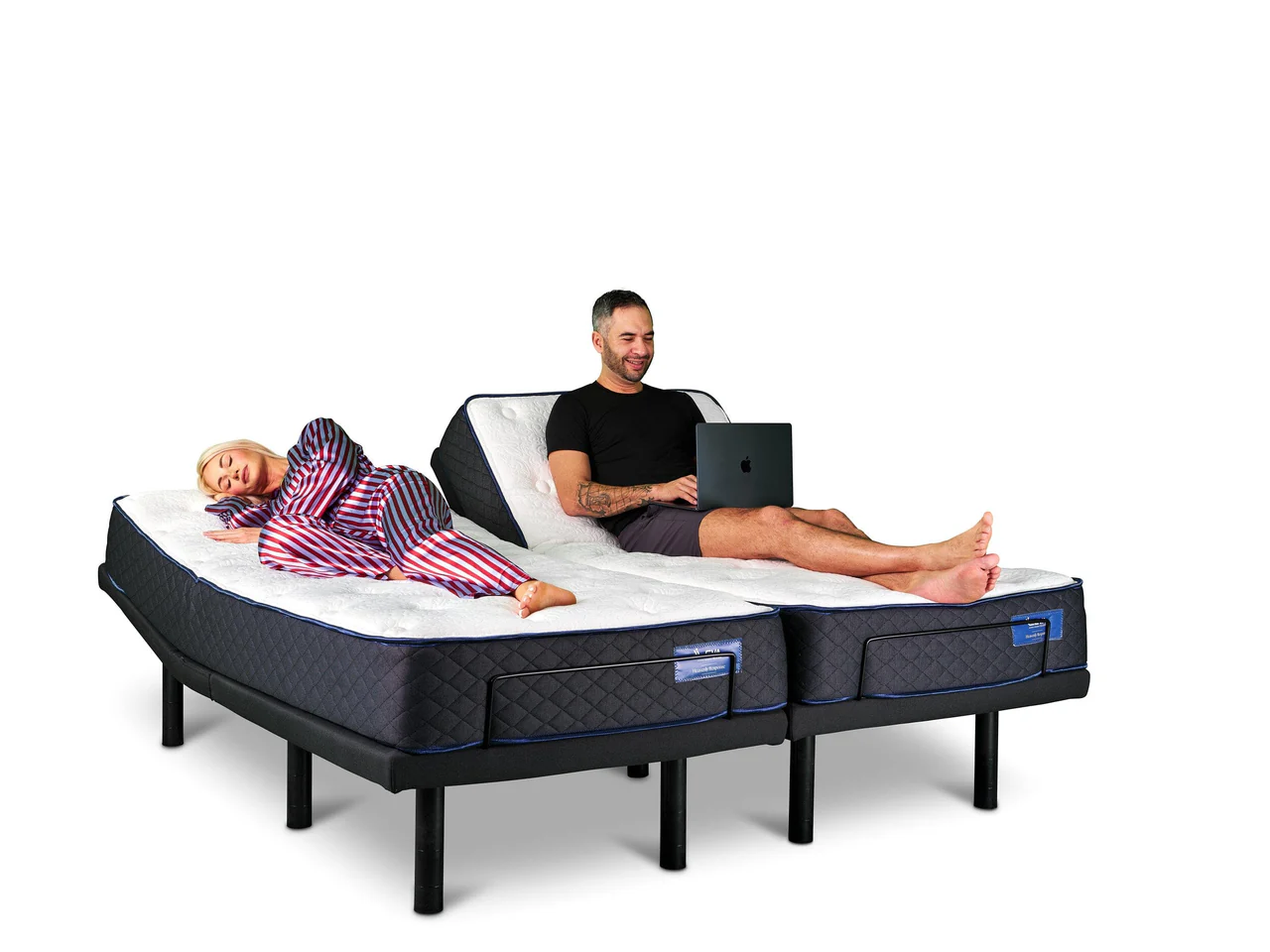
Total cost of ownership at Leva Sleep sits 30–50% below comparable luxury competitors because Leva designs and assembles systems locally and sells direct-to-consumer without retail markup. This pricing advantage extends to the full sleep system, since white-glove delivery, available for a fee, includes bedroom setup, leg-height adjustment, a full product tutorial, and old bed removal, which removes the hidden costs of self-installation. Leva’s specialized bedding line, including deep-pocket fitted sheets with extra elastic, duvet clips, and mattress protectors, is engineered for adjustable bases and solves the sheet-slippage problem that undermines standard bedding. Mattresses are American-made and available in all-foam or hybrid pocket-coil designs within the compatible 10–14 inch thickness range.
2. Tempur-Pedic TEMPUR-Ergo Smart Base (Split King)
The Tempur-Pedic TEMPUR-Ergo Smart Base includes Snore Response™ technology that senses snoring and automatically raises the head approximately 12 degrees. This automatic detection system places the base in the advanced tier alongside Leva Sleep. The base uses the Snore Response™ system described earlier and pairs it with Tempur-Pedic’s app for position memory and remote control.
Consumer testers appreciated the personalized automatic anti-snore mode, which raised the head or pulsed the bed when snoring was detected, though not all chose to use it regularly. The base is sold through retail partners and Tempur-Pedic stores, which adds retail margin to the final price. Buyers should confirm that their Tempur-Pedic mattress falls within the compatible thickness range for the base’s articulation system.
White-glove delivery availability varies by retailer and region. Bedding is not proprietary to the base, so most buyers source compatible fitted sheets separately. At full retail, the TEMPUR-Ergo Smart Base in split king configuration sits in the premium price tier, significantly above Leva Sleep’s equivalent system for similar automatic anti-snore functionality.
3. Saatva Adjustable Base Plus (Split King)
The Saatva Adjustable Base Plus relies on a preset anti-snore mode instead of automatic detection. The anti-snore mode slightly elevates the head to ease airway pressure, but users may need to experiment to find the best angle for their body. This places the base in the preset tier, which works well for users who know their preferred elevation angle but does not react to real-time snoring events.
Saatva includes white-glove delivery as a standard service, which separates it from many entry-level brands. The base supports independent controls in split king configuration, and Saatva mattresses are designed to pair with the base. Motor noise specifications are not independently published, so buyers should request in-store or in-home demonstrations before purchasing.
Pricing falls in the mid-to-upper range. Saatva does not sell a proprietary bedding line engineered for adjustable articulation, so buyers should budget for deep-pocket sheets separately. The preset-only anti-snore system limits functionality compared with automatic detection options at similar price points.
4. Sven & Son Essential Split King Adjustable Base
Sven & Son offers split king adjustable bed bases as an entry-level option in this comparison. The Essential model provides manual head and foot elevation with a wireless remote. Anti-snore functionality at this tier remains limited to manual preset positioning, so the user sets a head elevation angle before sleep with no automatic detection.
Sven & Son mattresses feature slip-resistant bottoms and are available in split king configurations, which partially improves bedding compatibility. Optional in-home setup for Sven & Son starts at $265, or $365 without haul away. Free curbside shipping is standard for Sven & Son adjustable bases and bundles, with typical arrival in 6–8 business days, which suits buyers comfortable with self-directed setup at a lower price point.
The Essential model works for couples who want independent elevation controls on a limited budget and who do not mind setting their anti-snore angle manually each night. Buyers who prioritize automatic detection, very quiet motors, or integrated bedding systems will likely find this tier too basic.
5. GhostBed Adjustable Base (Split King)
GhostBed’s split king adjustable base appears widely through wholesale and retail partners and offers manual preset head and foot elevation with wireless remote control. Anti-snore functionality remains limited to preset positioning. The base is marketed as a general-purpose adjustable foundation rather than a snoring-focused or couples-focused system.
Motor noise and elevation range specifications are not independently verified by a published third-party test. Delivery runs through standard freight or retail partners depending on the purchase channel, and white-glove setup does not come as a standard feature. GhostBed does not sell a proprietary bedding line designed for adjustable base articulation.
GhostBed’s broad distribution model means pricing and service quality vary by channel. Buyers comparing GhostBed to Leva Sleep should weigh the absence of automatic anti-snore detection, integrated bedding, and standard white-glove delivery against any base price difference. See how Leva Sleep’s automatic anti-snore detection and integrated bedding compare in person at the La Jolla showroom or by exploring the full system online.
Split King Adjustable Base Comparison for Snoring
| Base | Head-Elevation Range | Anti-Snore Method | Motor Noise | White-Glove Delivery |
|---|---|---|---|---|
| Leva Sleep Split King | Wide therapeutic range | Automatic app-driven micro-adjustment | Whisper-quiet German motors | Yes, available for a fee |
| Tempur-Pedic TEMPUR-Ergo Smart Base | ~12° auto-raise via Snore Response™, full range not published | Automatic (Snore Response™ sensor) | Not independently published, varies by retailer demo | Varies by retail partner |
| Saatva Adjustable Base Plus | Not independently published | Preset (manual angle selection) | Not independently published | Yes, standard |
| Sven & Son Essential Split King | Not independently published | Manual preset only | Not independently published | Optional, from $265 (haul away not included) |
| GhostBed Split King | Not independently published | Manual preset only | Not independently published | Not standard |
How Split King Bases Change Couples’ Sleep
Couples who move from a flat shared mattress to a split king adjustable base often describe two types of change. The first appears immediately, as the snoring partner’s head rises on the first night and the non-snoring partner experiences fewer awakenings. The second is relational, since couples who had started sleeping in separate rooms often return to the same bed within weeks of installing independent controls, because neither partner must compromise their position for the other’s comfort.
A common scenario involves one partner with positional snoring, which worsens when lying flat, who had been using a CPAP machine reluctantly. After switching to a split king base with automatic head elevation, some users report reduced CPAP dependency for mild positional cases, although physician guidance remains essential for diagnosed sleep apnea. Another frequent outcome involves the non-snoring partner, who previously lay awake waiting for the snoring to stop, now sleeping through the night because the elevation adjustment happens automatically and quietly. The shared bed stays intact, and a potential sleep divorce is avoided.
Frequently Asked Questions
Is it safe to sleep with the head elevated every night on an adjustable base?
Nightly head elevation between 7 and 30 degrees is generally considered safe for healthy adults and matches the range used in clinical studies on positional sleep apnea. Most users adapt within a few nights. People with specific spinal conditions, recent neck or back surgery, or circulatory disorders should consult a physician before using sustained head elevation. Leva Sleep’s adjustable bases allow incremental angle changes so users can start at a low elevation and increase gradually as comfort allows.
Can a split king adjustable bed help with mild sleep apnea?
Head-of-bed elevation can reduce the frequency and severity of breathing interruptions in positional obstructive sleep apnea, where airway collapse worsens when lying flat. Elevating the head shifts soft tissue forward and reduces upper airway collapsibility. However, adjustable bed elevation does not replace a CPAP machine or other physician-prescribed therapy for moderate to severe sleep apnea. Anyone with a diagnosed sleep apnea condition should discuss positional therapy options with their sleep physician before modifying or replacing their current treatment.
How do I stop fitted sheets from slipping off a split king adjustable base?
Standard fitted sheets are not designed for repeated articulation and often pull free at the corners when the head or foot section rises. Bedding engineered for adjustable beds solves this issue by using deep pockets and reinforced elastic that wraps fully around the mattress perimeter, not just the corners. Leva Sleep designs its bedding line, including fitted sheets, duvet covers with clips, and mattress protectors, for adjustable base use. A mattress bridge accessory can also reduce the gap between the two Twin XL mattresses in a split king configuration.
How loud are the motors on a split king adjustable base?
Motor noise often goes underreported in reviews yet can be very disruptive in real bedrooms. Entry-level bases with basic DC motors may produce humming or grinding during adjustment, which can wake a sleeping partner. Premium bases use brushless or precision-engineered motors that operate below the threshold of sleep disruption. Leva Sleep’s split king bases use whisper-quiet German motors selected specifically for silent operation. When evaluating any base, request a live motor demonstration at the showroom or during a home trial before committing to a purchase.
When should a couple consult a physician instead of relying on an adjustable bed for snoring?
An adjustable bed suits positional snoring in otherwise healthy individuals. A physician consultation becomes necessary when snoring appears with breathing pauses during sleep, gasping or choking sounds, excessive daytime sleepiness despite adequate sleep time, morning headaches, or difficulty concentrating. These symptoms may indicate obstructive sleep apnea, which requires formal diagnosis through a sleep study and may need treatment beyond positional adjustment. Leva Sleep’s systems can complement physician-prescribed therapy but are not a medical device and should not replace professional evaluation for suspected sleep disorders.
Conclusion: Finding the Right Split King for Snoring
Choosing the best split king adjustable bed for snoring in 2026 comes down to four criteria: a head-elevation range that covers the 7–30 degree therapeutic window, independent per-side controls, quiet motors, and a clear choice between manual preset and automatic real-time detection. Automatic detection, available in Leva Sleep’s 2026 app-driven system and Tempur-Pedic’s Snore Response™, delivers responsive, hands-free adjustment that preset-only bases cannot match. Leva Sleep provides this advanced functionality with white-glove delivery, integrated bedding, and American-made mattresses at the direct-to-consumer pricing described earlier, which removes retail markup while keeping luxury-tier features. Start with independent head elevation and move toward automatic detection for the most complete long-term snoring solution.